Wednesday, January 31, 2018

Week one

Wedding Makeup, 2013
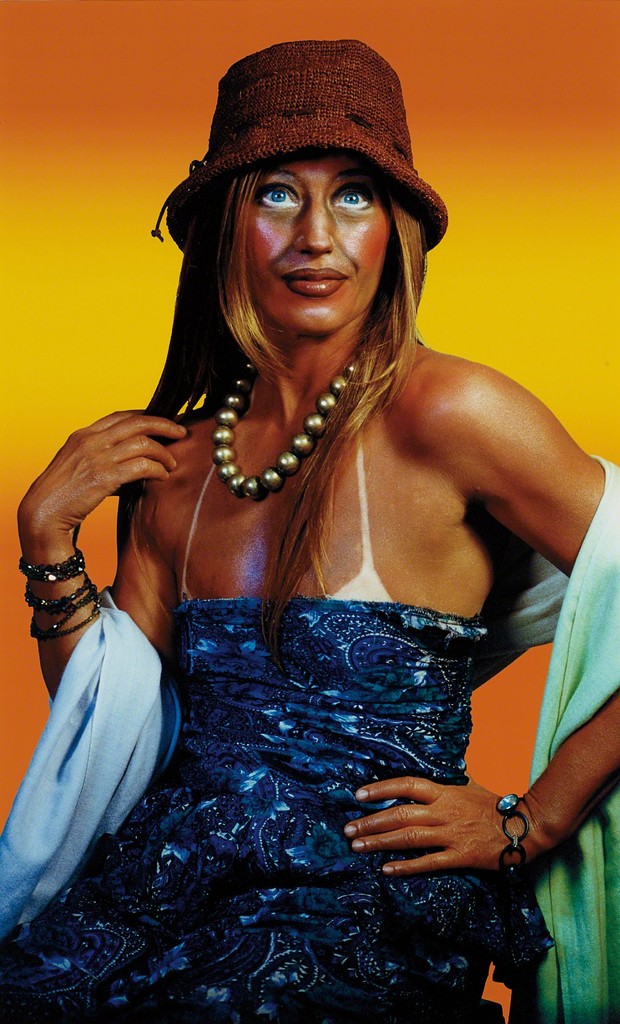
Untitled (Self-Portrait with Sun Tan), 2003


                          This Photograph was taken by a professional photographer during my sister's wedding.
I used this selfie as comparison with Cindy Sherman selfie where she is over tan and using a lot of make up because that is how I felt when I had to wear all that makeup that is everything but natural.

Sherman’s way of changing her appearance is fascinating because is an overrepresentation of our daily lives. Even though she did not have any feminist or political purpose when she took the pictures, they are a great way to represent stereotypes and what society expect from others, especially women. For example, her self-portrait with sun tan, I believe it is a representation of what women deal with all the time. [Some] Women feel the necessity to look as it is expected from society and therefore change their appearance in different ways, starting for their makeup. 


https://www.artsy.net/artwork/cindy-sherman-untitled-self-portrait-with-sun-tan
https://sophmoet.wordpress.com/tag/cindy-sherman/

Week two- Manufactured Reality


"Photographs really are experience captured, and the camera is the ideal arm of consciousness in its acquisitive mood."

This picture was taken by my sister in a trip we did with my family to San Andres Island in Colombia in 2017. I relate this picture with the quote because this photograph captured a perfect moment of happiness, and it not only remainds me of that specfic moment, but also, all the time shared with my family during the whole trip. I really belive that photographs are the best tool to capture moments and experiences in the perfect moment.


Week 2 Manufactured Reality


Photograph of the Niagara Falls, American Side.
Taken by me.

"While a painting or a prose description can never be other than a narrowly selective interpretation, a photograph can be treated as a narrowly selective transparency..."

Photographs are taken as truth. They cannot be "created" in the same way as words on a page or a painting on canvas can be. This misconception is so far reaching that one takes photo and video evidence as fact of the thing. But really, a photo is just a means to capture a moment and thus it can be altered as well. Doctoring or omitting information changes the fact. Here, I show the Niagara falls alsmos as the end of the world. From this angle the view does not know whether anything exists beyond this point and is left with only the view offered by this vantage.

Week 2


"Photographed images do not seem to be statements about the world so much as pieces of it, miniatures of reality that anyone can make or acquire." - Susan Sontag 
Golden Gate Bridge in San Francisco, California
Taken by: Me
It's strange to think that most people can describe how landmarks or other countries look, without ever having visited there. I had spent a semester in San Francisco and this photo was taken the first time I had ever been there. Although, I had never seen the Golden Gate Bridge before this day, I had seen it in photos, but it never seemed real until I had actually seen it for myself. I think this can be explained by Susan Sontag's quote in On Photography. There may already be millions of existing photos of this same bridge existing, this one is special to me because I took this one myself. As a result, I have a sense of entitled over it, although I obviously have no entitlement over the bridge itself, which I think is what Sontag is trying to convey. 

Week 2


Picture in Füssen, Bavaria, Germany
Taken by me

"To collect photographs is to collect the world." - Susan Sontag

    The general meaning of this quote is that photographs are memories that you collect no matter where you go. The photograph above was taken during the Spring in Germany. I went to Austria, Germany, and Switzerland for spring break with my high school. It was such an amazing experience to learn about their culture, go to concerts, and see how their lives are different than ours here. Throughout my two weeks visiting those three countries, almost every day was a cold, snowy day. This photograph will always let me have a memory of how beautiful Germany is. 

Tuesday, January 30, 2018

Evidence Through Photographs

"Photographs furnish evidence. Something we hear about, but doubt, seems proven when we're shown a photograph of it." - Susan Sontag

Photograph in Limon, Costa Rica 
Taken by: me
The central meaning of Susan Sontag's On Photography is that photography is important in many ways. One very important way is that it "furnishes evidence," as said in the quote I chose. To me, this means that it proves to the world that you went somewhere you said you went. It is actual evidence once you show a photo of it, rather than tell them. This reminded me of the recent cruise I went on. I felt like I needed to take a photo of every place I went to so I could show that I definitely went to all of those places. This is one of my favorite photos that I took during that cruise. It shows the place that I went to which is Limon, Costa Rica. It also shows the cruise ship we were on behind us, called the Monarch. I believe Susan Sontag is correct when she uses this example as a way to describe the importance of photographs and photography. Without the camera on my phone, I would not have been able to show the people I know and the world the places that I have experienced. 

References: On Photography

Week 2- Susan Sontag


“A photograph passes for incontrovertible proof that a given thing happened. The picture may distort; but there is always a presumption that something exists, or did exist, which is like what's in the picture.” -Susan Sontag

I was really able to relate to this quote. With all of the social media accounts that we may have, it is important for us to take photos of things that we have done and places that we have been. I personally love taking photos of the paintings that I create because it not only gives me a different view of the painting than what I have from looking at it in person, but when I look back at the photos of my work, it reminds me of the moments I had while doing them and the time I spent working on them. The photo to the left is of me in New Orleans this past summer, my partner took it of me right down the block from an awesome dessert spot we had went to together. The photo to my right is of my favorite painting. I tried to capture how I was feeling while doing this painting and by the end, I did not feel like it captured how I felt at all. I would create a painting, let it dry overnight, and then create a whole new painting on top of it. This went on for several days. The final product is of on and off work and my attempts at covering up the paintings before it.


week 1


While searching for artworks by Cindy Sherman, I realized that a lot of the work she did was very pro-woman which I love. Cindy Sherman represented all different kinds of women across the world which allowed women, including myself to really feel a connection with her work.  For this reason, I decided to search for interviews that she has done and I came across one that Sherman did for Interview Magazine. In this interview, she explained how critically she was doing well but that it was always important for her to challenge not only herself but her fans as well.  

Cindy Sherman began creating artworks that made people uncomfortable to see how they would react. This was interesting to me because many artists hope to get their work noticed and when they do, they continue to make what the people like to see. It was bold of Cindy Sherman to follow what she felt was best and make artworks that not everyone would like.

I drew inspiration from what I have learned about Sherman, the photographs she took, and the personas she took on. The photograph that I chose to use is called Untitled film still #16 and it was created in 1978. I attempted to recreate Cindy Sherman’s Untitled film still #16 by choosing a black and white filter and wearing a black dress similar to the one that she had on.
Related image

References:
https://www.youtube.com/watch?v=mZekNrhRWek
https://www.moma.org/interactives/exhibitions/1997/sherman/untitled16.html


Manufactured Reality

"In deciding how a picture should look, in preferring one exposure to another, photographers are always imposing standards on their subjects. Although there is a sense in which the camera does indeed capture reality, not just interpret it, photographs are as much an interpretation of the world as paintings and drawings are." Susan Sontag on photography.Photographers show what they want the audience to see, the same way painters do their work. If the photographer feels a beautiful woman is one that is of fair skin, slim and has blond hair, then that is what he will show. If the photographer wants to show what poverty looks like, the photographer will travel to communities filled with poor people. They do not capture reality but what they understand or feel that reality is in their own understanding.I remember being back in Africa watching American movies and the movies will show the rich, clean and beautiful areas of America. I believed that America was just beautiful and not so many gangs of black Americans. When I came here, I was blown away to see the sides of America that the films I watched failed to depict. The quote from Susan Sontag "clicked" because I experienced it.


The reality is that I'm proudly African but I try to portray other sides of Africans that the media fails to portray. As much as we are proud and embrace our culture, we also accept modern changes. We basically try to manufacture the reality of what the media portrays Africa to be. I'm torn between two cultures. It's hard to try and balance two cultures. I just need to be myself and do what I feel is the "true me." That's why I chose this picture


Week 2


"To photograph is to appropriate the thing photographed. It means putting oneself into a certain relation to the world that feels like knowledge -- and, therefore, like power".

I've always been interested in the 1940s-60s. A simpler time, yet filled with struggles of its own, but one where technology and social media didn't capture the attention of our siblings, friends, parents, significant other, children, and everyone in general. A time where we can go outside and just soak in the scenery that God created around us, and to just relax in it for a few hours. Reading a book, playing football, running around and exploring. Going on a date and actually engaging with the person you are with, not worrying about checking in on Instagram or taking a photo to take a post online later. While the mid 1900s had struggles and oppressions of its own, it also had its positives. Putting myself in this role made me think about how consumed I can be checking Facebook and Instagram, but not enough time in reading my Bible or painting portraits. Right after taking this photo, I really took about an hour and a half to finish reading that book that I never got to finish. 

Week 2: Susan Sontag


"Photographed images do not seem to be statements about the world so much as pieces of it, miniatures of reality that anyone can make or acquire". - Susan Sontag
I wanted to either make or find my own picture that really related to this quote and ended up settling on my own photo from years ago. I always came back to this picture because I didn't quite know when or where I took this photo. This really intrigued me and until I remembered what this picture was, I wasn't going to use it. At first glance, I thought this was snow on the ground in my backyard at night. I was fairly confident that it was until a piece of evidence came up. This photo was taken a couple years back...in August. Last time I checked, it doesn't snow in August where we live and I haven't vacationed anywhere far during that summer. As I think and think more, I start to recall taking a trip to the beach with my family and we stayed overnight in a hotel. That was when it clicked, "there we go". I took this at night when I wanted to take a walk across the beach before I headed back to my room. I faintly remember that I had to put the flash on when I take it as it would just be a black picture if I didn't. I found this picture to be kind of eerie to be honest but just as I didn't know what it was at first, I started to make my own manufactured reality of it which really tied in well with what Susan Sontag mentioned.

Week 2 Blog


Photographs furnish evidence.” To say a photograph furnishes evidence means that the photo is capturing a still moment in his that can be saved and viewed for as long as the picture is intact. A photo can be saved to remember a vacation, a loved one or a great time. They really allow you to relive the moment and allow all the feelings of that event to flood back weather its happiness or tears of joy. We take printed photographs and them but in books to create a timeless books of memories that stays in great condition for a long time and are accessible whenever we chose. 

The photo I chose this week is with from back to front my grandfather, father cousin, older brother and me. I really love this picture because it shows three generations of my family and how much we all love each other and all the time we spent together. Although we have a physical copy of this picture thanks to technology and the cloud I will be able to save this picture forever in hopes of recreating this image one day with a family of my own.

Week 2: Manufactured Reality

Cindy Sherman Untitled #578 the Series Hollywood, 2016

“Photographs, which fiddle with the scale of the world, themselves get reduced, blown up, cropped, retouched, doctored, tricked out.”
-Susan Sontag

    The overall meaning of this passage is how today in age, people use their image to alter their appearance. Photoshop has become really popular in this day and age, and people use it to change themselves. It is also being used in the art community as well. There are positive uses for photoshop and they are also negative uses as well. The positive thing about it is how a person can create good art and the negative is how people  use it to alter themselves and look like other people.


   For this assignment, I recreated a portrait from Cindy Sherman’s catalog. The portrait I selected was from the Series Hollywood Untitled #578. I used two different pictures to create my altered reality. I used photoshop to create this portrait. I cropped the background of my picture and then placed it on the forest picture for the background. I then did some editing to make certain parts of the background blurred.  


My References: 


Monday, January 29, 2018

Week 2 - Manufactured Reality

For this week's selfie assignment, I used a similar concept to last week's. I created a character and put him in his own world. In this assignment, however, I tried to further manufacture the reality captured in the photo by making it more unfamiliar and less "realistic". By combining a wizard costume, a crumbling stone wall, and some photo editing to look like magical energy, I created a fantasy scene that does not reflect everyday life but is captured as a photograph nonetheless.

Sunday, January 28, 2018

Week Two:Susan Sontag


As the sun sets: Avon Beach 

“In another version of its utility, the camera record justifies. A photograph passes for incontrovertible proof that a given thing happened. The picture may distort; but there is always a presumption that something exists, or did exist, which is like what's in the picture. Whatever the limitations (through amateurism) or pretensions (through artistry) of the individual photographer, a photograph -- any photograph -- seems to have a more innocent, and therefore more accurate, relation to visible reality than do other mimetic objects.”-Susan Songtag 

        This quote signifies a lot to me, because a photograph resembles much more than just an image. It captures a moment that happened, an event that one can always go back too. This picture was taken on my iPhone over the weekend on my trip to South Jersey. The temperature was incredibly freezing outside, but the beach has always been my favorite place to spend time and relieve stress. Getting a peek at that sunset, and not knowing the next time I would come across it forced me to make my friends pull over in order for me to capture the moment. The sky may never look the same again and I may never be able to get a picture as beautiful as I find this one, but it is the closest memory I carry with me of the beach for now. It is intangible and extremely distant, but it is the only physical connection available to me of that moment. My photography skills may not be advanced, or the camera that was used, and it is just another a picture in my gallery, but I can always hold the sunset and beach in my hands now.

Saturday, January 27, 2018

Week 1


I took this picture to see if I can come up with something similar to Cindy Sherman's work. I have never really put a scarf on my head in this form and felt that it would be nice to see how I would look. I wondered if I would look different from my usual look and at an angle that I have never tried.

I chose the work of Cindy Sherman, "Untitled (Madonna)" because it spoke a lot to me. She exposes the purity and religious aspect of a woman. When I first saw it, I remembered Mary the mother of Jesus from the film "Jesus of Nazareth." It portrays the innocence a woman has before she is corrupted by the evil of the world. Cindy also portrays the Muslim women as well because they cover themselves until all that's left for the human eye to see is their face.

She also shows that there is also beauty in decency of "covering up" and still using a few make-up products. From the documentary, she stated that she loved playing dress-up until she landed on a look that she could not recognize herself in. She reaches into various levels of creativity till she photographs what she wants the audience to see.


Through her work, she has inspired various artists to try different forms of art. Like some of her photographs on the clowns, I feel she inspired the video makers of the film, "IT" which is a hit horror film. She paved the way for women to embrace their individuality as well and providing them with self-confidence.

Wednesday, January 24, 2018

Week 1

This selfie I took in response to Cindy Sherman's own Untitled Film Still #21. I wished to capture the eyes most of all, the almost sort of fear-disgust that the eyes are portraying. As when someone gives you some bad news or you hear a backhanded comment thrown toward you, the eyes are the primary vehicle for emotion. Also, the mouth, the upper lips slightly pulled up in disgust. This I chose to show in more of a pursed lip fashion to, again, give off the negative vibe of dread or revulsion.
Untitled Film Still #21 speaks most volumes to me. When I see it it reminds me of what a woman might deal with walking through a rough neighborhood. Perhaps someone calling her an obscene name or making a perverse suggestion and then this woman retracting in some degree of fear, anger, and general disgust. This probably goes back to Ms. Sherman's living in 80s New York City.
Ms. Sherman did an interview with Kenneth Baker where she says: "Sometimes…. When I did the head shots, people felt that I was making fun of these characters, but I really felt they kind of endeared themselves to me..." She puts, into her work, an endearment and feeling toward her characters which shows that she does think of the way that they are portrayed and each feeling is deliberate. This is important when one looks at the broader depth of her works and how she works toward that finality.

https://walkerart.org/magazine/cindy-sherman-walker-art-center


x

Week 1: Cindy Sherman

Cindy Sherman has this incredible ability to disguise herself with a different persona in each of the works she creates, however these photographs were anything but self-portraits. By creating these characters, she challenged the notion which Susan Sontag proposed: "photographs furnish evidence", because Sherman's camera always lied. And, through her deceits, she looked for truths about identity, vulnerability and power. 

As an inspiration for my own self-portrait, I tried to channel Sherman's ideology about her images not having an explicit narrative or message, meaning they should be left open to interpretation. Specifically, I chose to recreate this image from Sherman's Untitled Film Stills. I was captivated by this portrait, because it was one of the few that I had seen where Sherman's face was not shown, which I thought was very interesting. Also, like the many others in this collection, this photograph looks as though it was somehow part of a film. As best put by Jamie Lee Curtis in Nobody's Here But Me (1994), "...that somehow she has created an entire film around that one frame of film that we never see, but somehow we know what the film is..." 

My self-portrait was taken last year when I had just gotten my camera and was experimenting with the different types of settings and lighting. In my photo, my hair is straightened, which I thought would be interesting to note because it's almost as though I am someone else (from a photography standpoint and in relation to Sherman). My photo was also edited into black and white, so that it closely resemble Sherman's image. 


References:
http://www.susansontag.com/SusanSontag/books/onPhotographyExerpt.shtml
https://www.youtube.com/watch?v=UXKNuWtXZ_U


Tuesday, January 23, 2018

Week 1- Improving or Hiding?


The portrait I chose to use was Cindy Sherman's self-portrait in which she had given herself a severe spray tan and too much make-up as an almost masking form. Just by looking at the photo alone, I felt as though I was looking at a woman who was trying to hide something about herself through spraying tanning and over doing it on the make-up. But it led me to a question of self reflection, "am I any better?"

The selfie I chose was taken back in June of 2017 after my cousins wedding. I had gone through 2 hours of hair and make-up on myself and still felt the need to "improve it" for people on my Snapchat by putting a filter on my face. Layers and layers of covering up all I felt was "unappealing" with myself, just to give others an image to look at in their perspective of beauty. I grew up believing that my identity was my beauty, and that my beauty can "always be improved". My family is of Puerto Rican decent (and is very religious), so my Tia Mara always says that "you are a form of God's temple. You must always keep it up to date and looking well kept". The more I think about it the more I realize, I am not look like Sherman's spray tanned form, but I sure felt like it. Hiding myself by masking it to others. 

In an interview Sherman did with The Guardian, she says that she realizes and accepts that her work is more than dressing up, but that "so much of it has been an examination of identity". As you go through much of her work, you can always find something to identify with in some aspect of life. For me, it happened to be the spray tanned woman. Make-up is my form of masking myself to others, and Sherman really depicted masking through "beauty enhancements" tremendously in this self-portrait. We try overcompensating through fashion and different beauty hacks we find out there, or in the jewelry we wear, or even in the materialistic things we buy, but are we improving our lives by doing these things, or are we hiding something about ourselves from the world?


External Sources:

https://www.theguardian.com/artanddesign/2011/jan/15/cindy-sherman-interview

Clown/Socialite Selfie


The photos above (left to right) are Cindy Sherman pieces called Untitled 2004 and Untitled 2007/2008. The photograph on the left is from Cindy Sherman's clown series and the image on the right is from her socialite portraits. 

"The images draw from her series Clowns (2003–04), made in the aftermath of the 2001 US terrorist attacks; Society portraits (2008), and work made in conjunction with fashion houses Balenciaga and Chanel," according to theguardian.com. The clown series interests me so much because it was fascinating how easily she could change her whole persona and I wanted to know why she chose a clown. While researching for this answer I came across an interview she had with clownlink.com. Her response to why she chose clowns as a subject is "I like that balance – that you could be painted to look like you’re happy and still look like you’re sad underneath, or the opposite too." It was even more interesting to know that she created the series following the 9/11 series. In my opinion, the clown series could be more towards the people who were trying to put on a brave face in the midst of a tragedy. They are a sad clown. They're trying to put on a happy mask but seem to look sad. 

Sherman's socialite or centerfold portraits are also about society. She is showing the ambiguities of women playing gender cliché roles. Her images aren't simply stereotypes of magazine spreads, it is carefully thought out images of pretty women who you can somehow tell are playing a cliché societal role. I believe this series of her art is a big reason why she has "inspired a generation of younger artists to explore their own identities across a range of mediums," as artnews.com said. 


Looking at these two series also inspired me to think about how I display myself and how I actually feel when I am trying to display myself in a certain way, through selfies and even when I'm walking around. I decided to use these two series to influence the selfies I took. I wanted my experience to be similar to what I think Cindy Sherman's experience was as she was home or out with Robert Longo as she created Untitled Film Stills. I tried on different clothes as it showed she did in the documentary. I played with different ways to change my look, even if it was only a little bit. I shot my pictures at home like Sherman usually did in her loft. I rearranged my vanity set to try to show glamorous items and photos like she rearranged her loft to look like a motel room. In my first photo, I tried to capture a similar film essence to Sherman's film stills. I added a black and white filter and grain. I cut up hair extensions to use as fake bangs. I put on really dark eyeshadow and eyeliner and red lipstick and then smudged it to make myself look similar to a clown. In the first photo, I am putting on the persona of a model when in reality my face is covered with a mask and smudged lipstick. I combined centerfold model with a scary clown. 

Clownlink Interview
Clowns and Socialite photos

Week 1 - Cindy Sherman


Cindy Sherman is best known for introducing a new way to use photography. By using herself as a model, but changing the way she looked in each photo, she created a type of self-portraiture where the subject is not actually oneself. This was an especially interesting concept considering the main use of photography as a means of documentation. As Susan Sontag wrote in On Photography, "To collect photographs is to collect the world", and "photographs really are experience captured". Cindy Sherman created fictional worlds and experiences in her photographs, conflicting, yet ultimately adding to, photography's original purpose. Additionally, Sherman's repeated self-publication "mirrored...the zeitgeist"(Hoban 2012). In other words, it is similar to the way that people now post millions of selfies, photos, videos, and other images of themselves online, many of which portray some kind of alter-ego or specific persona.


For my selfie assignment, I took inspiration mainly from Cindy Sherman’s Film Stills series. I created a character out of myself and scenes to put the character in. Some details were improvised in Sherman’s typical fashion, such as the poses, locations, and lighting in the photos. I experimented with a few different backdrops and poses, as well as camera angles, taking some of the photos myself and asking someone else to take others. However, I did have a few specific ideas in mind throughout all this experimentation, mainly about the character herself and the atmosphere I wanted to create. The character is based off of an imaginary alter-ego I created a few years ago. I had a particular idea in mind as to how I wanted her to look and spent a long time fixing my hair and makeup to match this. As it turns out, I did not look exactly as I had expected, but improvised with the look I had created. In my photographs, I tried to portray an atmosphere of passion and danger through dim lighting and the use of the color red in both my costume and surroundings. Just as Sherman was influenced by films she had seen, I allowed films and other media I have been exposed to to influence me. Throughout my life I have been avidly interested in the media and aesthetics of the 1960s, which hugely influenced the photos I took for this project. I wanted to create a similar aesthetic to 1960s photographs and films I have seen, particularly Peter Cook and Dudley Moore’s Bedazzled. Aside from its undeniably 1960s atmosphere (it was made in 1967), the film uses the color red as a repeated theme to represent the Devil.  Although I did not use red in the exact same way, I was inspired by the use of such a bold and expressive color.


It is true that Cindy Sherman has heavily influenced photography and the way it is used in self-presentation and today's image-based culture. I feel as though she influenced me personally before I even learned about her. While, as is common on social media, I always make sure to take photos of myself that show a particular self I want to present, I have also experimented with creating completely different "selves" through the use of makeup, costumes, and photo editing. This made Sherman's work look familiar to me, and I'm sure it looks familiar to many others. The prevalence of images similar to hers, whether created as art pieces or casually posted to social media, shows how influential a concept she introduced with her work.


Sources: 

Hoban, Phoebe. “The Cindy Sherman Effect.” ARTnews, 6 Aug. 2012, www.artnews.com/2012/02/14/the-cindy-sherman-effect/.

Sontag, Susan. On Photography. 2010.

Donen, Stanley, director. Bedazzled. 1967.

“Bedazzled (1967 film).” Wikipedia, Wikimedia Foundation, en.wikipedia.org/wiki/Bedazzled_(1967_film).

Cindy Sherman [Jan Castaneda]


               I chose one of Cindy Sherman’s Untitled Film Stills for inspiration for the assignment. She enjoys the idea of using her own image as if she were part of a narrative, thus I was drawn to the idea of an image I had taken that resembled a film scene. Her self portrait depicts her sitting on the side of the water, somewhat contemplating. The image is black and white, and her clothing makes it look like a scene from a 1950’s film. Sherman’s images examine the roles of women throughout history and society, my image on the other hand, was meant for an Instagram post.
               My selfie was taken during a trip to Mohonk Mountain Resort, there was a lake and it was during Thanksgiving. Since the sun sets much earlier during the season, I thought it would create a perfect lighting for a photograph. I wanted to utilize the contrasting light sources, from the dark shadows underneath the roof and the setting sun behind. The image is not shot straight out of camera and I did use some of Instagram’s editing tools to make the image warmer and emphasize the fall colors from the trees and my clothing.
               I was lucky enough to have rummaged through my phone to find an image similar to Cindy Sherman’s in terms of composition. Unlike a typical self-portrait, where the subject’s gaze aims straight towards the camera, Sherman’s and my image look off into distance. In a film, the characters do not make eye contact with the camera so as to maintain the difference in space and environment. Sherman’s portraits display a scene from a film which has been captured at a specific point during the performance.

http://www.artnews.com/2012/02/14/the-cindy-sherman-effect/

Week 1


CINDY SHERMAN SUNDANCE FILM               PHOTOGRAPHED BY SINDIA CONDE
FESTIVAL EDITIONS

   The selfie I chose for Week 1 was taken last year. My friend and I were walking to Liberty State Park to do a photoshoot. We are both into photography and the day that we went to take this photoshoot was a few days after a snow storm. It was an extremely cold day. My friend had a class assignment due on black and white pictures, so she wanted to take some pictures of the scenery and of me.
   "To collect photographs is to collect the world" Susan Sontag once said. One aspect that I have seen in Sherman's work is how she puts in all her power of knowledge to make her photographs feel like they are the appropriate thing to be photographed. In her photographs, there is always fashion which is ideal. She has influenced many people.
   Cindy Sherman was the type of person to create natural and unique photos. In the fall of 1977, her second gallery contained more than 70 photos including a housewife, working girls, or just girls on the run. The gallery was named "Untitled Film Stills," and they were all in black-and-white. Sherman impacted the art world due to her connection between paintings and photographs. Even though she did use Photoshop at times, her works were still one of a kind.

http://www.theartstory.org/artist-sherman-cindy-artworks.htm#pnt_1